

Bridget Riley
July 3 2026 long-term view, Dia Beacon
Exhibition
Bridget Riley
long-term view
Dia Beacon
Beacon, New York, July 2, 2026—Dia Art Foundation today announced further details of Bridget Riley at Dia Beacon. This focused presentation brings Bridget Riley’s vital work to Beacon for the first time, building on Dia’s initial engagement with the artist in 2000–01 with the exhibition Bridget Riley: Reconnaissance at Dia Center for the Arts at 548 West 22nd Street in Chelsea. Bridget Rileyopens on July 3, 2026, and will be on long-term view.
“With Bridget Riley’s work, viewers are challenged to become acutely aware of their own acts of looking. Through a seemingly restrained visual language, she generates an extraordinary sense of movement and space. Riley’s exploration of perception places her in a fascinating dialogue with many of the artistic tenets Dia has long been engaged with,” said Jessica Morgan, Dia’s Nathalie de Gunzburg Director.
One of the most influential painters of the postwar period, Riley creates complex paintings and drawings that produce striking optical effects and activate the space between the work and the viewer. Emerging in the 1960s, she developed a style of precise geometric compositions that use line, shape, and pattern—and later color—to produce optical instability. Across six decades of her practice, she maintained a rigorous investigation into how visual phenomena can generate both physical and emotional responses in the viewer.
Featuring three works from the collection that have never been shown at Dia before, this presentation brings together six of Riley’s earliest black-and-white paintings, created between 1961—when she first began making works of this kind—and ’64, including one of her rare shaped canvases. Featuring a range of painstakingly intricate line-based and geometric motifs, each work induces dynamic visual and physical sensations, the compositions appearing to compress and expand as the viewer moves around them. Although Riley introduced color into her work in 1967, never to return to a strictly black-and-white palette again, these paintings demonstrate the breadth of perceptual effects she was able to achieve with minimal means and how these formative years forecast her decades-long concern with spatial relations within and beyond the canvas.
“Although Riley has been the subject of several exhibitions outside the United Kingdom and Europe in recent years, she remains under-recognized in the United States. This exhibition offers Dia’s audiences a critical opportunity to experience the early experiments with rhythm and contrast that catapulted her to international acclaim and placed her at the center of New York’s art discourse in the mid-1960s. At once futuristic yet characteristic of their time, these works’ optical effects are irreproducible through a photo or screen, both reflecting and rejecting the digital age,” said Emily Markert, curatorial associate.
“Riley’s examination of geometric forms and color reached a critical point in her black-and-white paintings of the 1960s, a body of work that initiated her sustained engagement with the mechanics of perception as a primary subject. More than five decades after they were made, these paintings remain radical in their visual effect, resonating with the continuously shifting conditions of seeing in contemporary culture,” said Liv Cuniberti, curatorial assistant.
Bridget Riley was born in London in 1931. She studied at Goldsmiths, University of London, from 1949 to ’52, and at the Royal College of Art from 1952 to ’55, initially producing figurative and landscape paintings before developing an optically driven style in 1961. Since the mid-1960s, her work has been presented internationally, including in the pivotal exhibition The Responsive Eye at the Museum of Modern Art, New York (1965), and the Venice Biennale (1968), where she represented Great Britain. Recent solo exhibitions include Bridget Riley Drawings: From the Artist’s Studio, the Art Institute of Chicago (2022–23), traveling to the Hammer Museum, Los Angeles (2023), and the Morgan Museum and Library, New York (2023); Bridget Riley: Perceptual Abstraction, Yale Center for British Art, New Haven (2022); and Bridget Riley: Learning to See, Turner Contemporary, Margate, United Kingdom (2025–26). Riley was named a Commander of the Most Excellent Order of the British Empire in 1974 and appointed the Companion of Honour in 1999. She has also been awarded a 2003 Praemium Imperiale from the Japan Art Association, the 2009 Kaiserring of the City of Goslar, and the 2012 Rubens Prize of the City of Siegen. Riley lives in London.
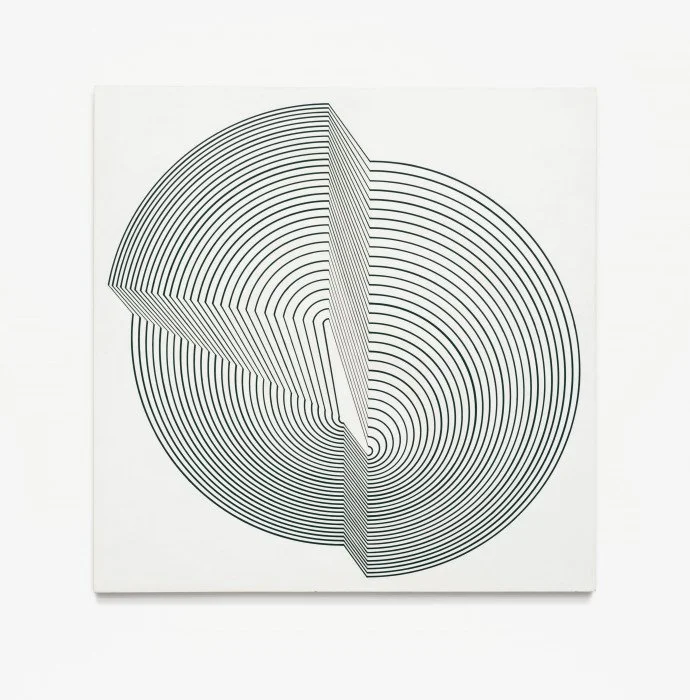
Interrupted Circle, 1963

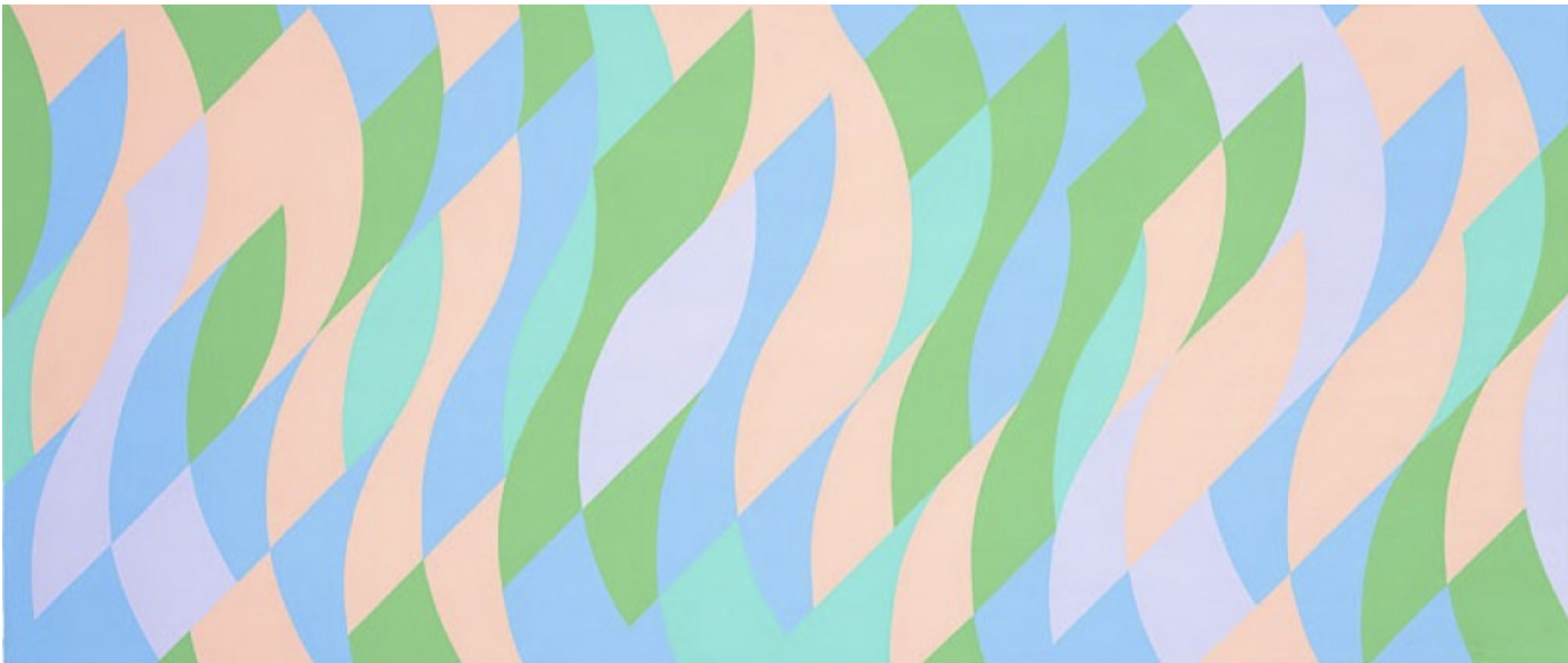
Straight Curve, 1963
Enchant, 2004
Artists
Artists recommended by A+CA to promote art research, cultural exchange, and inspire the next generation through learning, exploration, and creativity.